
Find the Fireman’s Seat
A 100-year-old rail car, a diesel from the same year, and why the biggest changes from AI come well after the tool arrives.
I rode in a rail car built in 1926. It is Southern Railway coach 4679, a 46-seat car Pullman built for a steam railroad, and it runs today at the North Alabama Railroad Museum in Huntsville, where an all-volunteer group has been preserving railroad equipment since 1966. The line it runs on ends behind Wilson Lumber, which started in 1949 and is where I used to work. After a hundred years the car still does the job it was built to do. The machine a business owner should study is a different one, and it sits at the same museum.
The other machine from 1926
The museum also owns Boxcab No. 11, a small diesel locomotive finished in 1926, the same year as my coach. It started out as a demonstrator in a steel mill yard. In 1926 steam pulled nearly every train in the country, and nothing about a little yard engine looked like the future. It was the kind of machine that would retire steam.
Thirty-four years
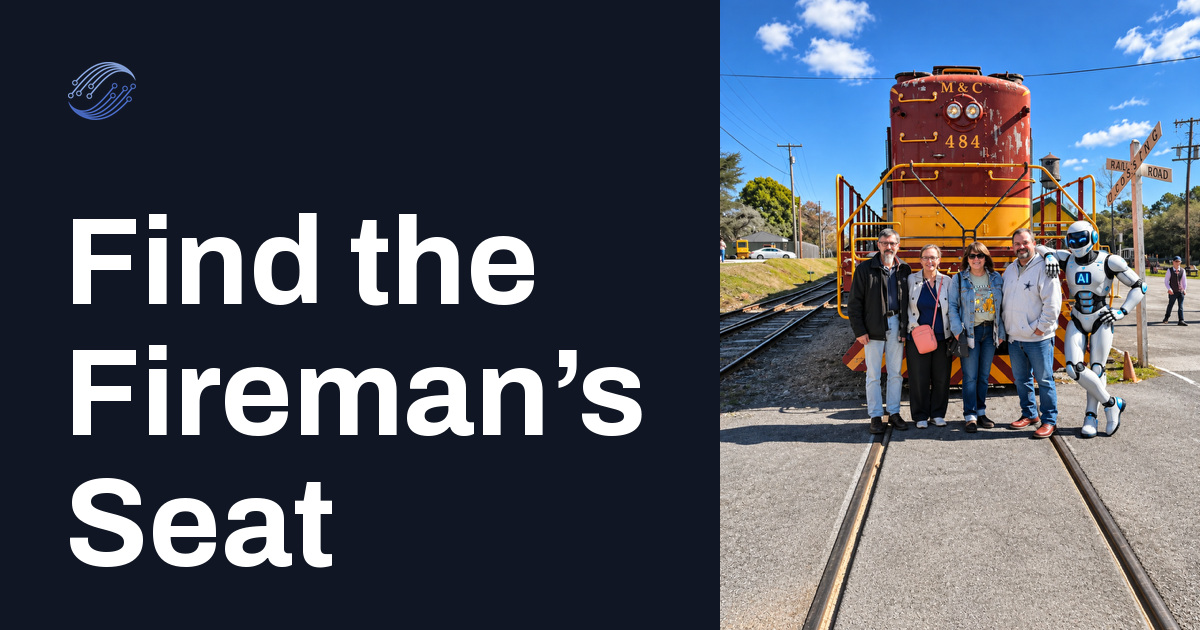
In 1949, the year Wilson Lumber started, ALCo built No. 484, the diesel we had our picture taken with at the museum. As late as 1951 the country still had more steam locomotives in service than diesels. Regular main-line steam on the big railroads did not end until 1960. From the year my coach and that boxcab were built, that is 34 years.
Diesel won because of what a railroad could stop paying for. It burned less fuel, needed less maintenance and could run with a smaller crew. It also needed no water tanks, no coaling towers and no roundhouses. The locomotive was the purchase. The savings were everything steam required that the railroad no longer had to own, staff and repair. A railroad that bought diesels and kept paying for all of that got the cost of both.
The seat that outlived the fire
The word that matters in that list is could. A steam locomotive needs a fireman, somebody to tend the fire and keep water in the boiler. A diesel has no fire. In 1963 the railroads still had about 33,000 firemen’s positions on diesel freight and yard engines. Congress had to set up an arbitration board to settle it, and that board ruled that about 90 percent of those positions were no longer needed.
Notice what happened in between. The seat changed before it went away. By 1953 an MIT thesis on the diesel and railroad workers described the fireman’s work on a diesel as inspection and patrol. The firing was gone and the man was still there, doing different work. Meanwhile the shops were turning over. A diesel has no boiler, so the boilermakers were hit hard, and by 1954 their union was down to 8,302 railroad members. A diesel-electric is full of electrical equipment, so the electricians gained work. Some seats changed, some went away and some were created.
I am not going to argue a labor dispute sixty years later. Both sides had their arguments, and the ruling came with protections for many of the men already in those jobs. The firemen were not doing nothing. The question was whether that work still needed its own seat. The seat was built for the old machine, everybody was used to it, and nobody riding in that cab had the authority to take it out. That is what I mean by a fireman’s seat: a seat that outlives the reason it was created. Sometimes it is a whole job. More often it is part of one, a step, a report, an approval or a handoff that exists only because the old way needed it.
Same seats, better engine
At the dealers and mid-market companies I work with, I have not seen AI eliminate a seat. What has changed is how the people in those seats work. They research an issue faster and solve it faster. Decisions are speeding up, because people can use AI as a thinking partner and to analyze how a workflow can be improved. That is true in any position where the person is actively using AI.
Take a Director of Operations at one of the companies I work with. An operating issue that used to take him days or weeks to analyze and answer now takes minutes or hours. I would put him at least 50 percent faster. He is still the Director of Operations. What he can do from that seat has completely changed.
In September I wrote in The Decision Layer, my weekly newsletter on AI for lumber and building materials dealers, that your people got faster and your company didn’t. That is the stage the fireman’s seat was in for decades. The engine was better and the crew was the same. No seat has gone away and no new one has been created. The work inside the seats is what is changing.
Some seats will go and others will be created. One new seat I expect to see is an AI champion or AI manager. That is my read, and the railroads are my reason for it. If I am wrong, companies will run AI in every seat for years and end up with the same seats. At a dealer with 35 or 40 people nobody is spare, so the owner who sorts the seats early gets to move good people into the new seats instead of being caught by surprise. The people in the seats that go are usually ones you would rather have on the counter, on the phone with a builder or chasing a late delivery.
Sort the seats before somebody else does
On the fireman’s seat the railroads could not settle it. It took an act of Congress, 37 years after that boxcab was built. An owner has a better option. Take one department and look at every seat in it. Each one lands in one of three groups: it stays as it is, it changes, or it goes. Then start a fourth list for the seats that do not exist yet. My read is that most seats where people are actively using AI are in the second group today, and that the third group and the new list start filling in from here.
To sort a seat, write down each thing it does, how many hours a week it takes and which group you think it belongs in. Then ask three questions of each one.
- Why does this exist? Name what it protected against when somebody added it.
- Is that reason still true? Many steps exist because information was hard to find, hard to read or lived in one person’s head. Check whether that is still the case with the tools you already pay for.
- Would we add it today? If you were setting this work up this week, would it make the list?
Look first where information gets typed into two systems, such as a supplier’s price change re-keyed into the ERP, where a weekly report goes out and nobody acts on it, where an approval exists because the approver was the only person who could see the numbers, and where a handoff exists because one person was the only one who could read the document. Be careful with approvals. Better information does not remove the need for a control, so before you drop one, know what it protects.
Then comes the part only the owner can do. The people in the seats should help redesign the work, because they know where the workarounds and exceptions are. They should not be expected to decide what their own seat becomes. Somebody with authority over the whole operation has to make that call, and tell the person in it before anyone else.
What the diesel did not fix
One caution, because the railroad story has a hard ending. By 1960 the railroads had finished the changeover, and the industry kept declining for another twenty years. Jeffrey Schramm’s history of dieselization, Out of Steam, makes the point that a better locomotive could not fix problems that had nothing to do with the locomotive. Diesel cut the cost of pulling the train. It did nothing about the passengers who had left for the highway and the airport. Coach 4679 is in a museum.
So take both lessons. Redesigning the work in those seats is what makes you cheaper and faster at the business you have. It does not tell you whether your customers will keep buying the way they buy today. Spend some of the hours you get back on that question.
You do not have 34 years
The railroads had 34 years and, in the end, an act of Congress. I do not think AI gives any of us that long. The tool is already in the building, and your competitors have the same one. Nobody is going to convene an arbitration board for your company, so the seats stay the way they are until the owner goes looking. Pick one department this month, sort the seats, and find the first one whose reason has changed.