Agreed by Doing Nothing
Issue 21
The Headline Story
Every yard has a Facebook page. Somebody set it up years ago to post the Saturday hours, the truckload sale on treated lumber, and a picture of the new forklift. Whoever has the login keeps it going, and nobody thinks about it until something breaks. I’m no different. An outside firm runs our social media, and when I read Meta’s new rules this week, I couldn’t tell you who has full control of our account. I’m sending them a note to find out.
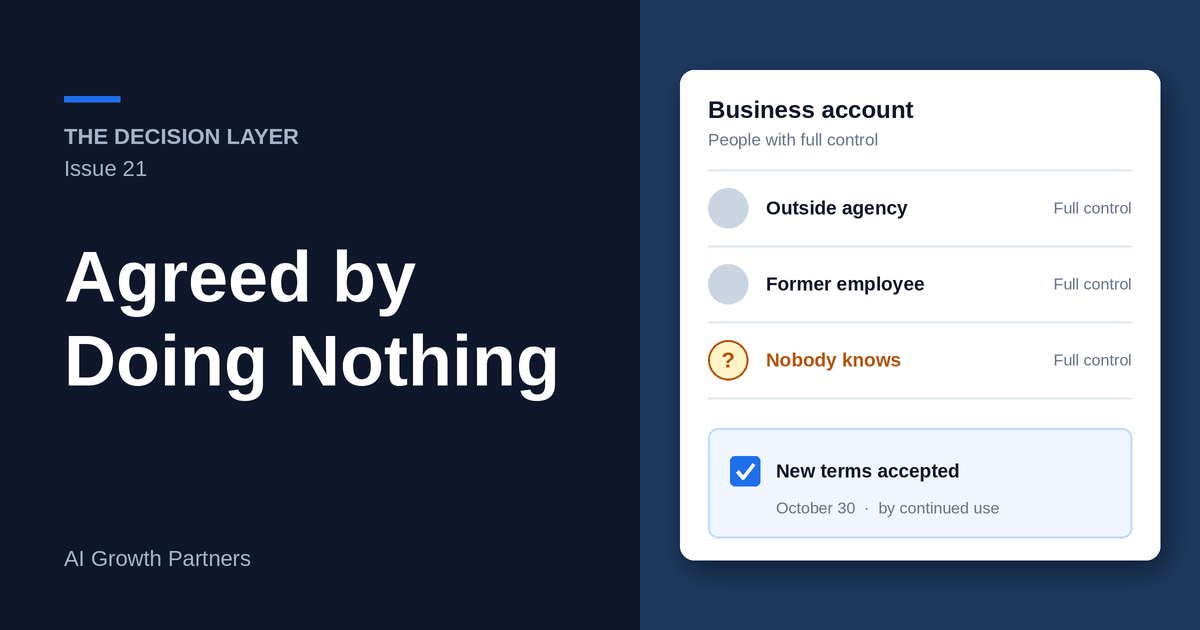
On October 30, Meta’s new rules for business accounts take effect. If your company keeps using its Facebook page, Instagram account or Facebook ads after that date, you have agreed to them. You can’t accept part of them. The only way to say no is to stop using Facebook and Instagram for business.
Here is what you are agreeing to. Meta’s software can read your company website and keep coming back for changes. It can even sign up for its own login to get past pages that ask for one. Meta says it wants accurate product information for the ads and suggestions it shows on Facebook and Instagram. If you saw headlines that Meta would train its AI on business websites, Meta dropped that wording Friday after newspaper publishers complained. The reading of your website stayed.
That fight was about newspapers, and it isn’t yours. After October 30, more of what Facebook and Instagram say about your yard will come from your website, read by a machine. Somebody at your company accepted that without knowing it. Anything on your website a stranger can see, that machine can see too. That includes any page behind a login that anyone can create, which for some yards means contractor pricing.
Don’t shut the page down. Your customers are on Facebook. Find out who holds the keys to it, and what a stranger can see on your website.
What Else Mattered
On Friday, Fed Chair Kevin Warsh said the flood of money going into AI is a shock to the economy. His point: money pouring into data centers and chip plants raises demand now, and the productivity those projects promise comes later. The Fed raised rates a quarter point in September, its first increase since 2023, and meets again October 28. Warsh didn’t tip his hand, and markets expect the Fed to hold.
Your builders don’t care about AI models. They care about what a construction loan costs and what a buyer’s mortgage payment looks like. The Fed chairman now names AI spending when he talks about inflation, and that reaches your yard through your builders’ order book.
The Pattern Behind the Week
The thread running through this week is who acts in your name. Meta’s rules get accepted for your company by whoever keeps posting to the page. A customer’s assistant fills out your quote form for him. Software drafts the plan set an architect will stamp. In each case something is speaking for someone who isn’t in the room, and the person it speaks for owns the result.
Owners already manage this with people. You decide who can quote, who can extend credit, and who can sign for a delivery. What’s new is that some of what acts in your name, and in your customers’ names, is software, and nobody handed it that authority on purpose. Make it a decision, starting with the accounts and pages you already have.
What to Do Now
- Before October 30, find out who controls your company’s Facebook business account. Ask whoever posts for you to pull the list of people with full control. A former employee, an outside agency or a relative who helped years ago can keep accepting rules in your company’s name. The company should own that account, and at least two people who still work for you should have full control.
- Second, have whoever runs your website sign up for an account on it the way a stranger would. If that new account can see contractor pricing, job quotes or customer account pages, fix it so those pages open only for accounts your people have approved. In Issue 20 I asked you to check your site on a phone. Now check it with a stranger’s login.
- Third, ask that same person whether your website tells Meta’s software to stay out. That instruction lives in a small file called robots.txt, and Meta says the new rules don’t override it. Let Meta in, and your public pages feed its ads. Keep it out, and Meta has less to go on when it describes your products. Either answer is defensible. Not knowing isn’t.
What I’m Watching
- ChatGPT filling out web forms. On Thursday OpenAI let ChatGPT, in its Work mode, fill out forms and send messages inside the Chrome browser for whoever is using it. Your quote request form was built for a person. I want to see how many requests start arriving filled in by somebody’s assistant, and whether your people can tell.
- AI-drawn plans. Blueprints AI, a Santa Monica startup, says its software turns a sketch into a full set of construction drawings checked against local code. A licensed professional still reviews and stamps them before permit. It sells to architects and developers for $3,200 to $8,500 a month. If drawing plans gets that cheap, the stack on your estimator’s desk gets taller.
One Question Worth Asking
Who at your company is about to accept Meta’s new rules on your behalf, and do they still work for you?