
Someone Who Knows
Issue 20
THE HEADLINE STORY
Sometime this fall a remodeler will stand at your counter with his phone out. On it is a deck calculator: boxes for width and depth, a joist spacing setting, a waste slider, a framing sketch, and a shopping list that recalculates as he taps. He asked ChatGPT for it.
On Wednesday OpenAI began rolling out GPT-6 in ChatGPT with what it calls Intelligent UI: answers that come back as small working tools, not just paragraphs. On Thursday it started reaching the free version. OpenAI says more than 1.2 billion people use ChatGPT every week.
I tested it the way a homeowner would, on a paid account with memory off: a 16 x 12 deck on my house, tell me what to buy. Its lumber counts matched a second AI-built calculator line for line. That’s one deck and two machines agreeing, not proof either is right. But it was honest. It called its sizes preliminary, marked the structural fasteners to be determined, said it had not established whether the framing or footings were adequate, and asked how high the deck sits. The free version runs a lighter model, and I didn’t test it.
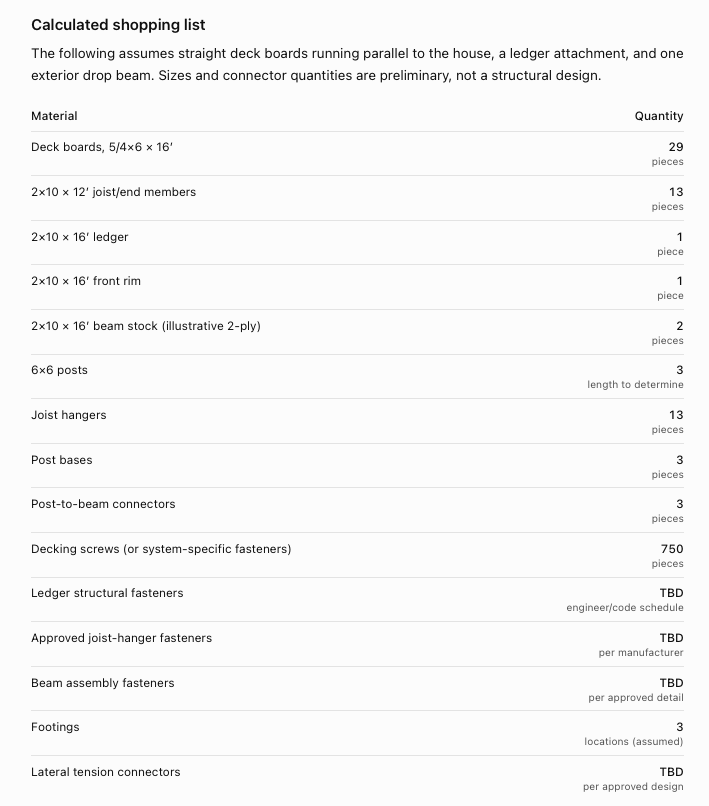
What the tool handed back is the part it wouldn’t do: joist size, footings, how the ledger attaches, what ties the deck to the house. It told him those come from the plans and someone who knows. The question is whether your counter can take those open lines and get them answered right, from the plans, the span tables, the manufacturer’s literature or the inspector. A yard that does earns the order. A yard that rings up the phone’s list, 2x10s it called an initial takeoff size and all, has let the phone do the selling and nobody do the checking.
WHAT ELSE MATTERED
The customer’s AI also got a front door this week. On Tuesday Meta and the customer-service software company Sierra announced a standard for how a person’s AI agent signs in and does business with a company. On Friday Sierra published the first draft and added 35 more design partners, including OpenAI, Target and Visa. The agent starts on the company’s website as a guest, checking whether a product is available or what the return policy says.
It’s a draft, and no LBM company is on either partner list. I don’t expect a contractor’s agent at your yard this quarter. But whatever your website says about hours, delivery cutoffs and what you stock is the first thing a customer’s agent will read.
THE PATTERN BEHIND THE WEEK
Three of this week’s stories point the same way. Customers’ phones now build the material list. Their agents are getting a standard way into a company’s website. And OpenAI is about to test ads in free ChatGPT. More of the easy part of serving a customer, counting, looking things up and comparing, is moving onto the customer’s own device, and those tools will keep getting better.
What stays with the yard is what no phone can do from a distance: knowing what’s actually on the ground, getting it there on the right day, finding the substitute when something’s short, getting the open questions answered right, and standing behind the order when the job comes up short. That was always where a good yard earned its margin. The difference now is that the customer can see where the free part stops.
WHAT TO DO NOW
- Set the counter rule before the first phone shows up. Don’t assume the phone’s counts are wrong or right; run them through the same check as any customer’s list. The lines it left open, joist and beam size, footings, ledger attachment and connectors, get answered from the plans, span tables, manufacturer literature or the inspector, never from a guess. Decide who at your yard owns that, and when it goes to an engineer.
- Build one tool yourself and prove it before anyone relies on it. Have your sharpest counter person paste this into ChatGPT or another AI tool that builds interactive calculators: “Build a deck material calculator for a lumberyard counter. Show every assumption it makes, like joist spacing, waste and screws per box, and mark which quantities depend on each one. Do not size joists, beams or footings; say those come from span tables and the plans.” Run ten decks you already closed through it, against what was actually used net of returns. If it doesn’t match on all ten, find out why before it goes near a customer. If it lives in Joe’s free account, it leaves when Joe does.
- Then spend fifteen minutes on your own website, on a phone. Check hours for every location, delivery cutoffs, holiday closures, and whether you actually stock what you list. Then name who owns keeping it right. If it’s wrong for a person, it’s wrong for the agent too.
WHAT I’M WATCHING
- Picture ads in free ChatGPT. OpenAI said Monday it will start testing labeled image ads later this month in its free and low-cost Go plans, shown while a picture generates. I want to see whether the big boxes buy their way in where homeowners picture their projects.
- Microsoft’s Autopilot, the Copilot agent that keeps working on its own. I’m still waiting for Microsoft to spell out whether it asks before contacting a customer or supplier, the question from Issue 18.
ONE QUESTION WORTH ASKING
When a customer’s phone tells him to get the joist size from someone who knows, is that someone at your counter?